
From Communication to Coaching: A Complete Framework for High-Performance Teams
How MD Associates’ Intervention Prevented Poor HR Practices from Derailing a Young Man’s Future
Note: To protect the privacy of all parties involved, the names of the young man, the facilities management company, and the global manufacturing organisation referred to in this case study have been anonymised. All events described took place in early October 2024. Although the organisation’s initial actions were deeply flawed, they ultimately acknowledged their mistakes and took significant steps to rectify them.
Supporting Employees with Differing Abilities: When Crisis Leads to Positive Change
This is a true story demonstrating how organisations can fail employees with differing abilities — and how meaningful change can occur when those failures are properly addressed. We use the term differing abilities deliberately, as the word disability often carries unnecessary negative connotations.
For the purposes of this case study, we will refer to the young man involved as Joe. The organisation concerned is a national company employing over 3,000 people across the UK, which publicly promotes itself as being disability aware. However, Joe’s experience highlighted a significant gap between corporate messaging and real-world practice.
This case illustrates how a potentially devastating HR failure was transformed into a positive outcome through professional intervention, clear communication, and a willingness to learn. Within just two weeks, what began as a deeply distressing situation for a young autistic man entering his first job was resolved through structured support, honest dialogue, and decisive action. It demonstrates that even serious workplace failures can be addressed quickly when the right expertise is applied.
The Dream Job That Became a Nightmare
At 25 years old, Joe had never held a full-time job since leaving school. Like many autistic adults, his attempts to access employment through traditional routes had been frustrating and demoralising. He had completed multiple training programmes recommended by the Job Centre, none of which resulted in sustainable employment.
Eventually, after years of unsuccessful placements and courses, he was advised to register with local employment agencies — advice that almost caused him to give up entirely.
Just as Joe was losing hope, he received an interview offer from a nationally recognised facilities management company, working on the site of a global OEM. For Joe and his family, this felt like a long-awaited breakthrough.
The Initial Promise
Joe’s father was actively involved from the very start of the recruitment process. During the initial telephone screening interview, he was present to support Joe and clearly explained his son’s abilities, communication style, and support needs.
At the face-to-face interview, Joe’s father again accompanied him, carefully outlining Joe’s autism, his strengths, and the reasonable adjustments that would help him succeed. He stressed the importance of clear communication and structured support during Joe’s transition into the workplace.
Despite this openness and preparation, the handling of Joe’s employment exposed a serious disconnect between the organisation’s recruitment approach and its operational HR practices.
A Catastrophic Failure of Process
Joe’s first three days at work involved minimal preparation and support:
- A 15-minute induction video
- A 30-minute conversation
- No structured training programme
- No workplace adjustments
- No consideration of Joe’s specific needs
- Immediate expectation to work independently in an unfamiliar environment
Despite these challenges, Joe worked diligently and showed genuine commitment. There were no concerns regarding his attitude or effort.
On the fourth day, however, everything changed. A supervisor abruptly instructed Joe to leave the site, citing vague “health and safety concerns” related to crossing areas on the shop floor. No formal explanation was documented.
Two hours before the end of his shift, Joe was escorted to security, told to hand in his pass, and asked to leave the premises. No one contacted his family. Joe phoned his father himself, who arrived ten minutes later to find him sitting by the roadside in tears.
The seriousness of this situation cannot be overstated. The site was located at the far end of a large industrial estate near a river. Had Joe wandered off in distress, the consequences could have been tragic.
Multiple Legal Breaches Identified
In desperation, Joe’s family sought advice from a relative who recommended MD Associates — a consultancy with a strong reputation for supporting organisations and individuals, particularly in cases involving neurodiversity and workplace inclusion.
When Joe’s father contacted MD Associates, he spoke directly with a senior consultant with extensive HR and coaching expertise. From the outset, it was clear that this was not a standard HR consultancy. MD Associates demonstrated a deep understanding of both the legal protections afforded to employees with differing abilities and the practical steps required to build inclusive workplaces.
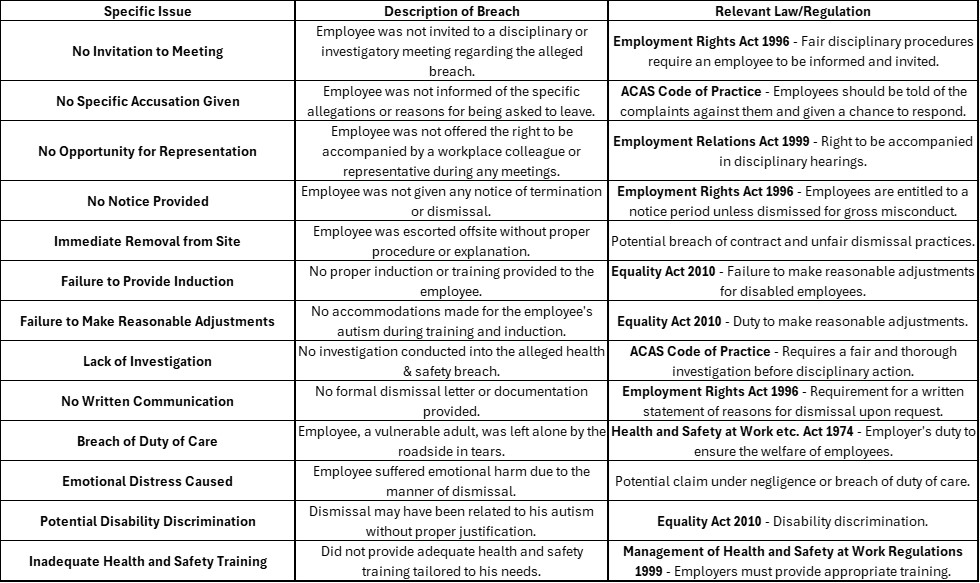
Following a detailed review of the case, MD Associates identified fourteen distinct breaches across seven separate laws and statutory obligations, including:
Employment Rights Violations
- No invitation to a disciplinary or investigatory meeting
- No clear allegations presented
- No opportunity for representation
- No notice period provided
- No written communication or dismissal documentation
Equality Act 2010 Breaches
- Failure to make reasonable adjustments for an autistic employee
- Potential disability discrimination
- No accommodations during induction or training
Health and Safety Failures
- Breach of duty of care to a vulnerable adult
- Inadequate health and safety training
- No proper investigation into alleged safety concerns
- Leaving a vulnerable individual alone by the roadside
The Path to Resolution
MD Associates immediately contacted senior figures within the organisation. While some initially failed to engage, a senior HR professional based at the company’s southern office responded constructively.
When presented with the scale of legal breaches and the potential for formal grievance proceedings, she requested time to investigate. It quickly became apparent that central HR had been completely unaware of the incident, highlighting a serious internal communication failure within a large national organisation.
Despite public claims of being disability aware, the organisation’s actions demonstrated a fundamental lack of understanding in supporting employees with differing abilities.
The Turning Point
Within a week, the HR representative returned to MD Associates with a clear admission: the company had made a serious mistake.
A meeting was proposed with Joe, though this understandably caused him significant anxiety. To ensure his wellbeing, it was agreed that his father and MD Associates would attend on his behalf.
At this meeting, MD Associates presented not only a comprehensive breakdown of the organisation’s failures but also a practical, structured roadmap for improvement. The company openly acknowledged that they had “no previous experience of dealing with this type of situation on this particular contract,” despite their size and public commitments.
This marked the beginning of meaningful organisational change.